American vs. European Trucks: Why They Look So Different
The visual and structural differences between American and European heavy-duty trucks are the result of distinct regulatory frameworks, infrastructure conditions, and operational patterns. While both vehicle types are designed for freight transport, their configurations reflect region-specific requirements rather than stylistic preferences.
Regulatory Framework and Dimensions
In the European Union, vehicle design is largely influenced by Directive 96/53/EC, which sets limits on vehicle dimensions and weight. Standard articulated vehicles are typically limited to 16.5 meters in length and 40 tones gross vehicle weight, with allowances up to 44 tones in certain intermodal operations.
In the United States, federal regulations establish a minimum standard for interstate highways, allowing:
- 48- or 53-foot trailers
- A maximum width of 102 inches (2.6 meters)
- A gross vehicle weight of 80,000 pounds (36.3 tonnes)
Unlike the EU, U.S. regulations generally do not impose a strict overall length limit on the tractor-trailer combination, provided the trailer complies with federal standards.
Vehicle Configuration
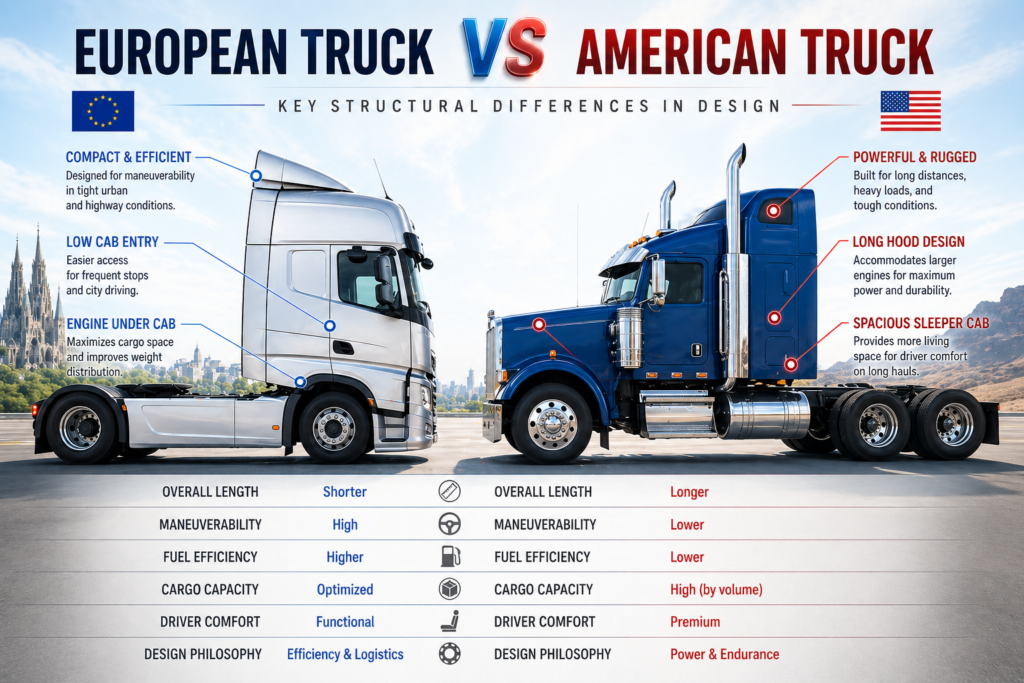
European trucks predominantly use a cab-over-engine (COE) design, where the cab is positioned above the engine. This configuration minimizes overall length and maximizes cargo capacity within regulatory limits. American trucks typically use a conventional design, with the engine mounted in front of the cab. This results in a longer vehicle but allows for different structural and operational advantages.
Infrastructure and Maneuverability
European road networks include:
- Dense urban environments
- Narrow roads and older infrastructure
- Frequent roundabouts and tight turning areas
As a result, European trucks are designed with:
- Shorter wheelbases
- Tighter turning radii
- Greater maneuverability
In contrast, U.S. infrastructure is characterized by:
- Extensive interstate highway systems
- Longer transport distances
- Wider lanes and intersections
This allows for:
- Longer wheelbases
- Increased stability at highway speeds
- Less emphasis on compact vehicle
Driver Operations and Cab Design
Operational patterns differ between the two regions.
In the European Union:
- Daily driving is typically limited to 9 hours, extendable to 10 hours twice per week
- Weekly limits include 56 hours and 90 hours over two weeks
In the United States:
- Drivers may operate up to 11 hours following 10 consecutive hours off duty
- The driving window is limited to 14 consecutive hours
Driver Operations and Cab Design
Operational patterns differ between the two regions.
In the European Union:
- Daily driving is typically limited to 9 hours, extendable to 10 hours twice per week
- Weekly limits include 56 hours and 90 hours over two weeks
In the United States:
- Drivers may operate up to 11 hours following 10 consecutive hours off duty
- The driving window is limited to 14 consecutive hours
These differences contribute to variation in cab design. European trucks are generally optimized for shorter, regulated driving periods, while American trucks often include larger sleeper compartments designed to accommodate extended time on the road.
Maintenance and Engine Access
The cab-over configuration used in Europe requires the cab to tilt forward for engine access. This design improves space efficiency but can increase the time required for certain maintenance procedures. American trucks, with front-mounted engines under a hood, typically allow easier access for servicing and repairs.
Freight Scale and Utilization
According to Eurostat, road freight transport in the European Union reached approximately 1,869 billion tonne-kilometres in 2024, with Poland accounting for nearly 20% of that total. In the United States, the Bureau of Transportation Statistics reports that approximately 20.2 billion tons of freight are transported annually across all modes, averaging about 55 million tons per day. These figures reflect large-scale freight systems operating under different structural conditions.
Design Implications
Despite differences in appearance, both systems converge on similar constraints in some areas. For example, maximum vehicle width in both regions is approximately 2.6 meters.
The primary distinction lies in how available length is allocated:
- European designs prioritize cargo space within strict overall limits
- U.S. designs allow longer tractor units while maintaining standardized trailer dimensions
Conclusion
American and European trucks represent two engineering approaches shaped by regional requirements. European vehicles emphasize compact design, maneuverability, and compliance with uniform regulations. American vehicles prioritize operational flexibility, driver accommodation, and suitability for long-distance transport.
These differences reflect adaptation to distinct transport environments rather than differences in technological capability or purpose.
~Cargoos Team